Data & BI Careers: Analyst, Engineer, and Scientist Compared
The data field is booming. With the rise of technologies such as artificial intelligence, big data, and automation, companies across all industries are investing in professionals capable of turning data into decisions. But despite the high demand, there is still a lot of confusion about the roles within this ecosystem.
So, what is the difference between a BI Analyst, a Data Analyst, a Data Engineer, and a Data Scientist? While they share tools and goals, their responsibilities are distinct yet complementary.
In this article, you’ll gain a deeper understanding of what each role does, how they connect, and which one might be most aligned with your professional goals.
🧠 Overview of the Roles
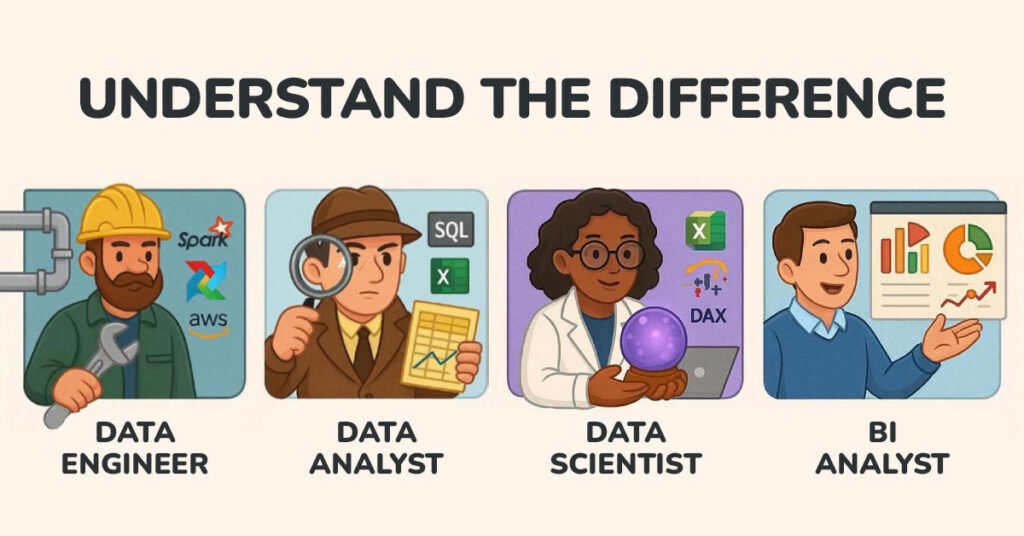
Before diving into each specific function, here’s a direct comparison of the main roles:
Role | Main Focus | Key Question Answered | Common Tools | Typical Profile |
|---|---|---|---|---|
Data Engineer | Infrastructure & data pipelines | How can we ensure high-quality data? | Spark, Airflow, AWS, Hadoop, Kafka | Technical, systems-oriented |
Data Analyst | Exploration & historical analysis | What happened and why? | SQL, Excel, Power BI, Google Data Studio | Investigative, detail-oriented |
Data Scientist | Predictive & statistical modeling | What might happen? | Python, Jupyter, Scikit-learn, TensorFlow | Mathematical, curious |
BI Analyst | Visualization & strategic insights | What does this mean for the business? | Power BI, Tableau, DAX, Qlik | Communicative, strategic |
🧱 Data Engineer: The Infrastructure Architect
The Data Engineer ensures that data is available, organized, and accessible for other data professionals. They build the technical foundation that supports the entire analytics operation.
Main responsibilities:
- Build data pipelines (ETL/ELT)
- Integrate diverse data sources (APIs, databases, files)
- Ensure scalability, security, and performance
- Monitor and maintain distributed systems
Common tools: Spark, Airflow, AWS, Hadoop, Kafka
Challenges:
- Handling unstructured data (logs, images, text)
- Guaranteeing fault tolerance in complex systems
- Optimizing processing time and storage
Where they work: Banks, e-commerce, digital platforms, and enterprises with robust data architectures
Ideal profile: Strong background in software engineering, systems architecture, and cloud computing
🕵️♂️ Data Analyst: The Corporate Investigator
The Data Analyst dives into historical data to understand what happened and why. They act as the bridge between raw data and operational insights.
Main responsibilities:
- Clean, organize, and explore data
- Build reports and dashboards
- Identify patterns, anomalies, and hypotheses
- Support decision-making with quantitative evidence
Common tools: SQL, Excel, Power BI, Google Data Studio
Essential skills:
- Descriptive & inferential statistics
- Data storytelling
- Knowledge of relational and non-relational databases
- Ability to translate data into accessible insights
Where they work: Companies of all sizes, especially in operations, logistics, finance, and customer service
Ideal profile: Investigative, detail-oriented, with logical thinking and strong communication skills
🔮 Data Scientist: The Algorithm Alchemist
The Data Scientist goes beyond descriptive analysis. Their focus is on predicting the future, finding hidden patterns, and automating decisions through mathematical and statistical models.
Main responsibilities:
- Build predictive and classification models
- Apply machine learning and deep learning
- Validate hypotheses with statistical rigor
- Work with large-scale and complex datasets
Common tools: Python, Jupyter, Scikit-learn, TensorFlow, PyTorch, Pandas
Essential skills:
- Advanced statistics and mathematical modeling
- Data-driven programming
- Model deployment & MLOps
- Techniques like regression, clustering, neural networks, and NLP
Where they work: Fintechs, healthtechs, startups, and companies that rely on forecasting and automation
Ideal profile: Curious, experimental, analytical, and technically skilled
📊 BI Analyst: The Strategic Translator
The BI Analyst transforms data into decisions. They create clear, strategic visualizations that help leaders understand the business landscape and act with precision.
Main responsibilities:
- Build interactive dashboards and executive reports
- Translate data into actionable insights
- Support decision-making with clear visual storytelling
- Work closely with business stakeholders
Common tools: Power BI, Tableau, DAX, Qlik, Looker
Essential skills:
- Dashboard visualization & UX design
- Business metrics (KPIs, OKRs)
- Communication with stakeholders and cross-functional teams
- Ability to synthesize large volumes of information
Where they work: Marketing, sales, operations, strategic management, HR
Ideal profile: Communicative, strategic, business-oriented, with strong technical skills
🤝 How These Roles Connect
Think of the data field as a value chain:
- The Data Engineer builds the infrastructure that collects, organizes, and distributes data.
- The Data Analyst explores and interprets historical data to understand what happened.
- The Data Scientist creates models to predict what could happen.
- The BI Analyst translates all of this into strategic, visual business decisions.
Each role is indispensable. Ignoring one compromises the efficiency of a data-driven operation. Companies that embrace this interdependence build stronger teams and make smarter decisions.
🔍 Which Role Fits You?
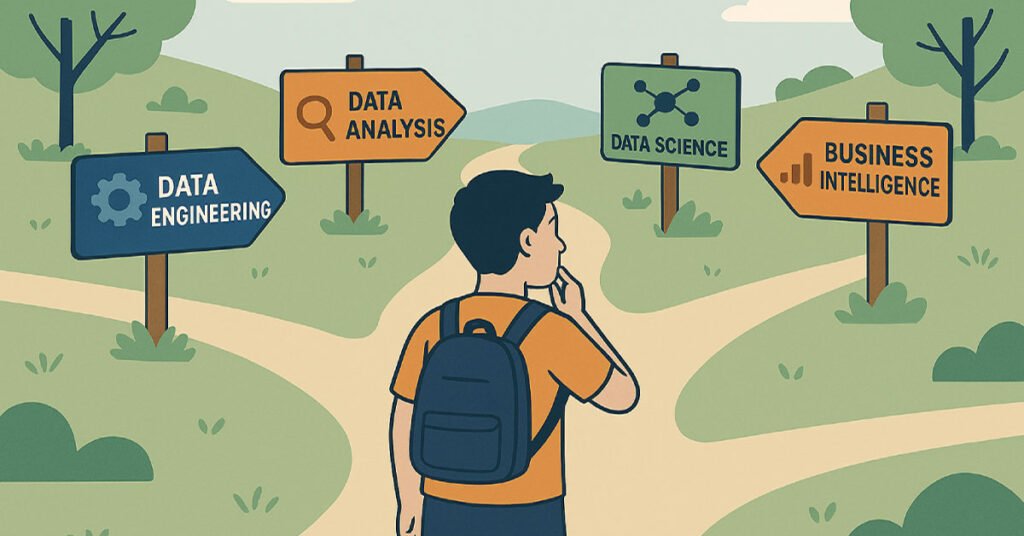
- Interested in infrastructure and systems? → Data Engineering might be your path.
- Love investigating and finding patterns? → Data Analysis is for you.
- Passionate about math and predictions? → Explore Data Science.
- Prefer to communicate and influence business decisions? → Go for Business Intelligence.